

Best Bathroom Vanities for Multifamily: What to Spec for Rentals
Ask a property manager what fails first in a rental bathroom and the answer is rarely the tile. It is the vanity: a swollen toe kick, a door that no longer closes, a top cracked around the bowl. Choosing the best bathroom vanities for multifamily has less to do with style than with how the cabinet handles water, cleaning chemicals, and a new resident every lease. Here is how we spec them.
What makes a vanity right for a rental
A vanity in a single-family home is used by one household for years. A vanity in an apartment is used hard, cleaned hard at every turn, and repaired by a maintenance tech working from a limited parts bin. That changes what the best bathroom vanities for multifamily have in common. When we build vanities for a property, we judge them on four things:
- How the box handles water. Moisture at the base and splash at the top are daily conditions, not accidents.
- How the top handles cleaning. Residents and turn crews use whatever is under the sink, and the top has to survive it.
- How it fits the unit mix. Several bathroom layouts on one property means several vanity widths, not one size forced into every wall.
- How it gets fixed. A hinge, a drawer slide, or a pull should be a parts swap, not a new cabinet.
Start with the box, because that is where water gets in
Most vanity failures start low. Water from a wet floor wicks into the toe kick and the bottom panel, and a slow drip at the trap sits on the cabinet floor until someone opens the door. The front can look perfect while the box behind it is coming apart.
- Box material. Plywood tolerates moisture better than particleboard, which swells at cut edges once water reaches them. On a sink base in a rental, that difference shows up within a few turns.
- Sealed edges and a finished interior. Every exposed edge is a place for water to get in, including the inside of the sink base where nobody looks.
- A toe kick built for mopping. The base of the vanity takes water every time the floor is cleaned, so it needs the same protection as the doors.
- Room for the plumbing. A sink base should clear the supply lines and the trap without anyone cutting the back panel or the shelf on site.
Tops, bowls, and faucet drilling
The top is the surface residents touch every day and the part most often replaced for looks during a renovation. For multifamily, what matters is fewer seams, a surface that cleans without special products, and a drilling pattern that matches the faucet you are actually buying.
- Integrated or undermount bowls. A top with the bowl molded in has no seam at the sink for grime to collect. An undermount bowl under a solid top gives a similar clean edge.
- A backsplash and sidesplash where the vanity meets a wall. That joint takes water every day, and a bead of caulk alone becomes a maintenance item.
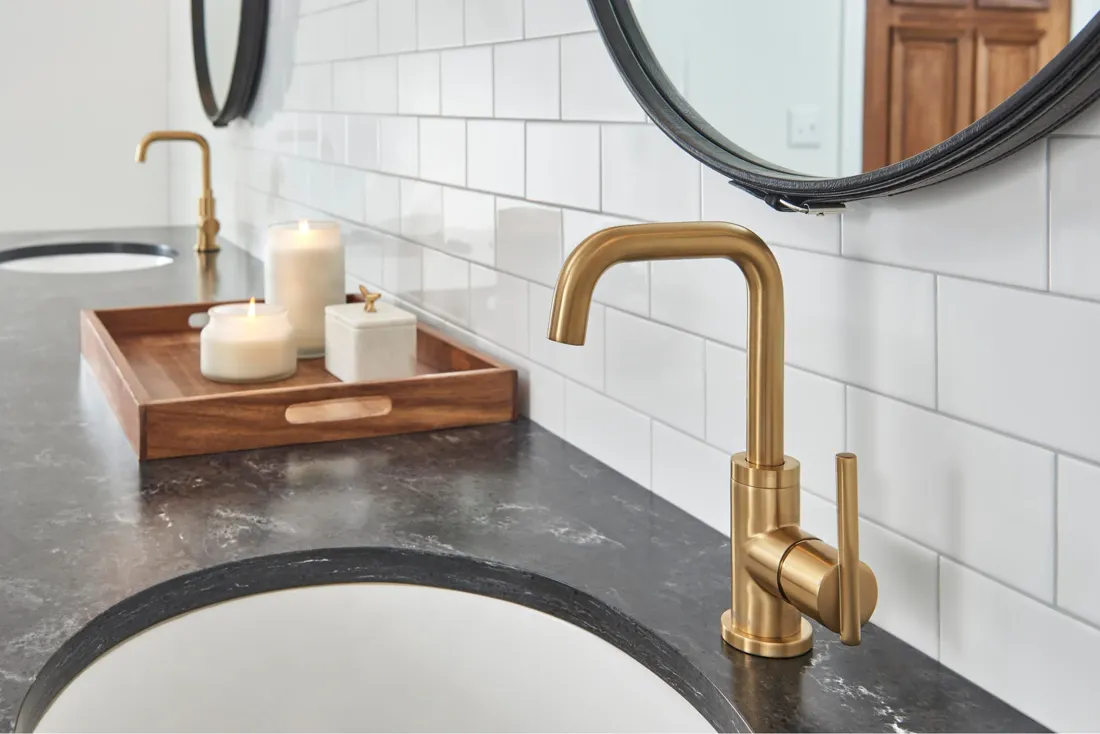
- Drilling matched to the faucet. Single-hole, 4-inch centerset, and 8-inch widespread faucets need different holes. A top drilled for the wrong one becomes a return or a cover plate.
- Drain and trap alignment. The bowl, drain, and trap location should be confirmed against the rough-in before the order is written, not discovered at install.
Size to the wall and the unit mix, not to a catalog
A property built in phases can carry several bathroom layouts, plus accessible units with their own clearances. Catalog vanities come in a handful of standard widths, so somebody on site ends up closing a gap with a filler strip or squeezing in a cabinet that crowds the toilet or the door swing. We price vanities per floor plan and build them to the wall, so width, depth, and height are a specification rather than a compromise.
The same thinking covers double vanities in primary baths, shallow-depth cabinets in tight hall baths, and accessible units where the vanity has to leave clearance underneath. Each one is its own run inside a single order, carrying the same door style and finish as the rest of the property.
Doors, drawers, and hardware a maintenance tech can fix
- Drawers where they earn their keep. A drawer bank beside the sink gives residents storage they will actually use. A drawer under the sink needs a cutout around the plumbing, which is worth confirming before production.
- Hinges and slides from one spec. The same hinge and slide across the property means one replacement part in the maintenance shop, not six.
- Pulls matched to the plumbing finish. Finish names are not standardized between suppliers, so buying pulls in the same program as the faucets is the reliable way to end up with one brushed nickel instead of two.
- Attic stock in the original order. Spare doors, drawer fronts, and a few full cabinets in the property finish cost far less at order time than a match sourced mid-lease.

Buy the vanity with the rest of the bathroom
A vanity sits at the center of a room that also holds a mirror, a faucet, shower trim, lighting, and often a glass enclosure. Bought from separate vendors, those pieces arrive on separate schedules in finishes that almost match. We would rather quote the vanity next to everything that hangs above and around it. Our guide to cabinetry for apartment renovations covers the refinish, reface, or replace decision for kitchens and baths, and our piece on LED bathroom mirrors for hotels explains why a mirror sized to the vanity run beats a catalog width.
Because we manufacture to order and ship factory-direct by the container, building to the unit is not an upcharge. It is simply how the order gets made, and it keeps warehouse carrying cost and distributor markup out of the price.
Send us the floor plans
We have managed, developed, and renovated 16,000 units and delivered product in 24 states, and the best bathroom vanities for multifamily have always been the ones specified for the real bathroom: the real wall, the real rough-in, and the real turn cycle. Send us your floor plans, the unit mix, and the faucet you plan to use. We will come back with bathroom vanities built to the wall, tops and hardware coordinated, priced as part of one bathroom package. Request a quote or call 317.306.5800.